


The Challenge
Local and state governments face a persistent, costly and deeply entrenched behavioral health crisis that strains provider resources and claims tens of thousands of lives every year. Demand for mental health and substance use disorder (SUD) services continues to far outpace the system’s capacity to meet it. With workforce strain adding to already existing fragmentation, organizations must do more with less to save lives. Leading behavioral health organizations leverage real-time, automated technology to augment efforts and improve access to care.

30M adults
in the U.S. do not receive the care they need

The Solution
OpenBeds® offers solutions for government health agencies seeking to better support healthcare providers and communities, while addressing common challenges such as ED overcrowding and long wait times due to inefficient referral processes. Through OpenBeds, states have the ability to create a wide network for collecting, analyzing and sharing actionable data. The cloud-based solution offers complementary clinician- and public-facing portals that connect providers and consumers to SUD and mental health treatment in ten states and counting.
OpenBeds facilitates rapid referrals and feedback by identifying and tracking mental health and SUD inpatient and outpatient treatment options in a single network.
OpenBeds Provides:
Decision support for providers and consumers, including detailed inclusion and exclusion criteria for specific services to ensure quality referrals to treatment

An inventory of outpatient and inpatient services, including available psychiatric, crisis, dual diagnosis, withdrawal management and residential treatment beds and wait times

A registry of social service resources available for direct or indirect referrals

Secure two-way provider communication for the digital exchange of necessary care information, such as medical records and consent forms

Comprehensive data aggregation and analytics capabilities
OpenBeds helps to ensure that individuals in need of mental health and SUD services are not left waiting for extended periods as providers search for suitable referral care. Treatment Connection™—the public-facing portal for consumers—streamlines access to care for individuals searching for their next step in their care journeys. Using a straightforward, easy-to-use format, it provides individuals with critical information to help them connect more efficiently to the most appropriate and closest care available in their communities. By facilitating smooth transitions to effective care, OpenBeds ultimately helps improve the likelihood of those patients having better outcomes.
FOR CARE TEAMS WORKING IN THE INTENSE AND DEMANDING ED ENVIRONMENT
OpenBeds offers the ability to see the longitudinal care record and quickly identify the most appropriate resources to match the level of care best suited to that individual’s specific needs. Based on that criteria, providers are then able to efficiently connect and schedule the closest available care through OpenBeds digital screening, intake and registration functions, which include the ability to coordinate prior authorization and peer support.
After discharge from the ED, clinicians can close the loop on referrals to ensure individuals are connected to needed treatment. They can use OpenBeds to track whether providers have accepted or declined those referrals. If the referral is denied, they can see the reasons why. Lastly, they can see whether or not an individual showed up for the recommended follow-up care or services.
FOR GOVERNMENT HEALTH AGENCIES
OpenBeds provides detailed data and analytics capabilities to help public health officials track key ED performance metrics. The solution’s analytics dashboard can be used to track real-time statewide user engagement, utilization, wait times from discharge to referral, and referral patterns. State agencies can track how efficiently EDs are handling referrals through OpenBeds date and time stamp functionality to determine whether individuals are being connected to treatment and services, and how quickly those connections are made. State officials also are able to identify trends in ED referral patterns to determine if and where there may be gaps in behavioral health resources. For example, they can identify if additional SUD services may be needed to serve rural communities where providers routinely have difficulty placing ED admits for treatment following overdoses.
OpenBeds is best utilized when there is extensive engagement among providers to ensure a robust network, with a full array of care options and referring providers to choose from. Having active participation of hospitals and health systems is critical to the success of OpenBeds across the states where its solutions are deployed. ED staff typically are onboarded as referrers in OpenBeds. This enables them to access the full spectrum of behavioral health treatment options in the state to help secure quality referrals to the most appropriate level of care for individuals presenting at the ED with behavioral health needs.
FOR PROVIDERS
OpenBeds facilitates optimal access by streamlining care transitions and replacing time-consuming manual processes that often require providers to call, email or fax multiple facilities individually to find available resources.
The Results

- Significantly shortened the amount of time waiting for referrals
- Increased access to care by increasing the number of healthcare entities integrated in the network by 173%
- Helps state partners to track key ED performance metrics
- Ultimately improves care patient outcomes for those in need of mental health and SUD services
Implementation of OpenBeds can help states have a positive impact on the overall ED experience, including facilitating faster referrals to the most appropriate care.
For example, one state client’s extensive provider participation has contributed to a significant increase in treatment referrals and decreased wait times since the state implemented its solution.
Prior to implementation, providers relied on a disjointed process for referring people through phone, fax and email communications. ED staff often spent undue amounts of time calling around to various facilities to find available treatment options, leaving many people in need to fall through the cracks as a result. Upon implementing OpenBeds, state officials led an aggressive engagement campaign to educate providers about the system, including how it worked and the numerous benefits of participating. More than 70 provider facilities statewide now actively participate as a result.
Within its first year, the state accommodated 20,924 treatment referrals, including 75% that involved inpatient services, and 57% voluntary and 43% non-voluntary referrals. The state has seen a 2.8% compound monthly growth rate in referrals through the network. Broad use of the system also has helped to significantly shorten the amount of time individuals have to wait for referrals. Over the course of the first 12 months, the proportion of receiving organizations that acknowledged a referral within 30 minutes or less steadily increased to a high of 65%.
NUMBER OF REFERRALS MADE BY REFERRING ORGANIZATIONS BY MONTH*
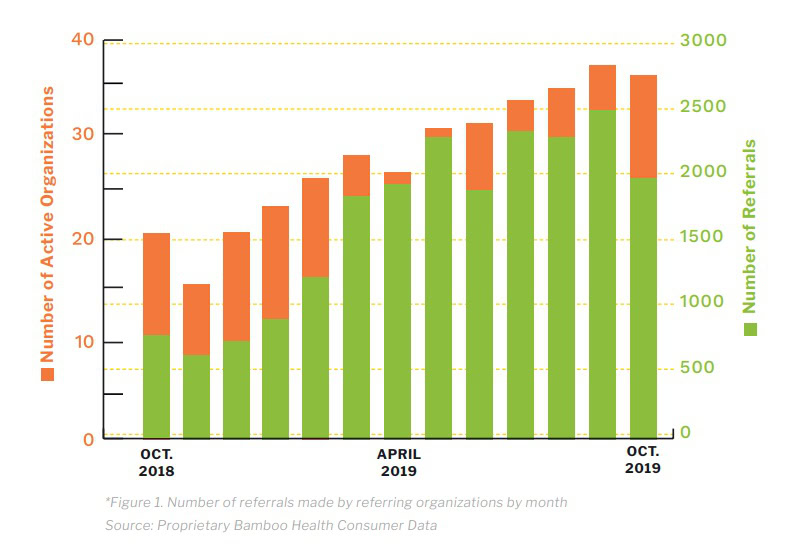
This has contributed to expanded access for individuals in need, with the number of active organizations growing 173% within the first year alone. Through the system’s data and analytics capabilities, state health officials are able to track overall referral patterns and identify specific problem areas, including the most commonly abused substances and difficult-to-place medical conditions, such as those with active psychoses, complex medical conditions, and developmental disabilities.
OpenBeds is helping officials and providers improve overall mental health and SUD services in the state, including streamlining referrals and shortening wait times by getting people to the right care, quickly. In addition, the system has helped the state’s department of health identify service gaps, effectively target funding, shape policy, evaluate program effectiveness and design and alleviate some of the treatment burden for clinical staff, social workers and other providers.


